A loss that puts cardiac arrest in the spotlight
Veteran actor Nana Patekar passed away at his home in Goa on 8 October 2026, aged 75. Early reports said he died of a suspected cardiac arrest. Our thoughts are with his family and his many admirers.
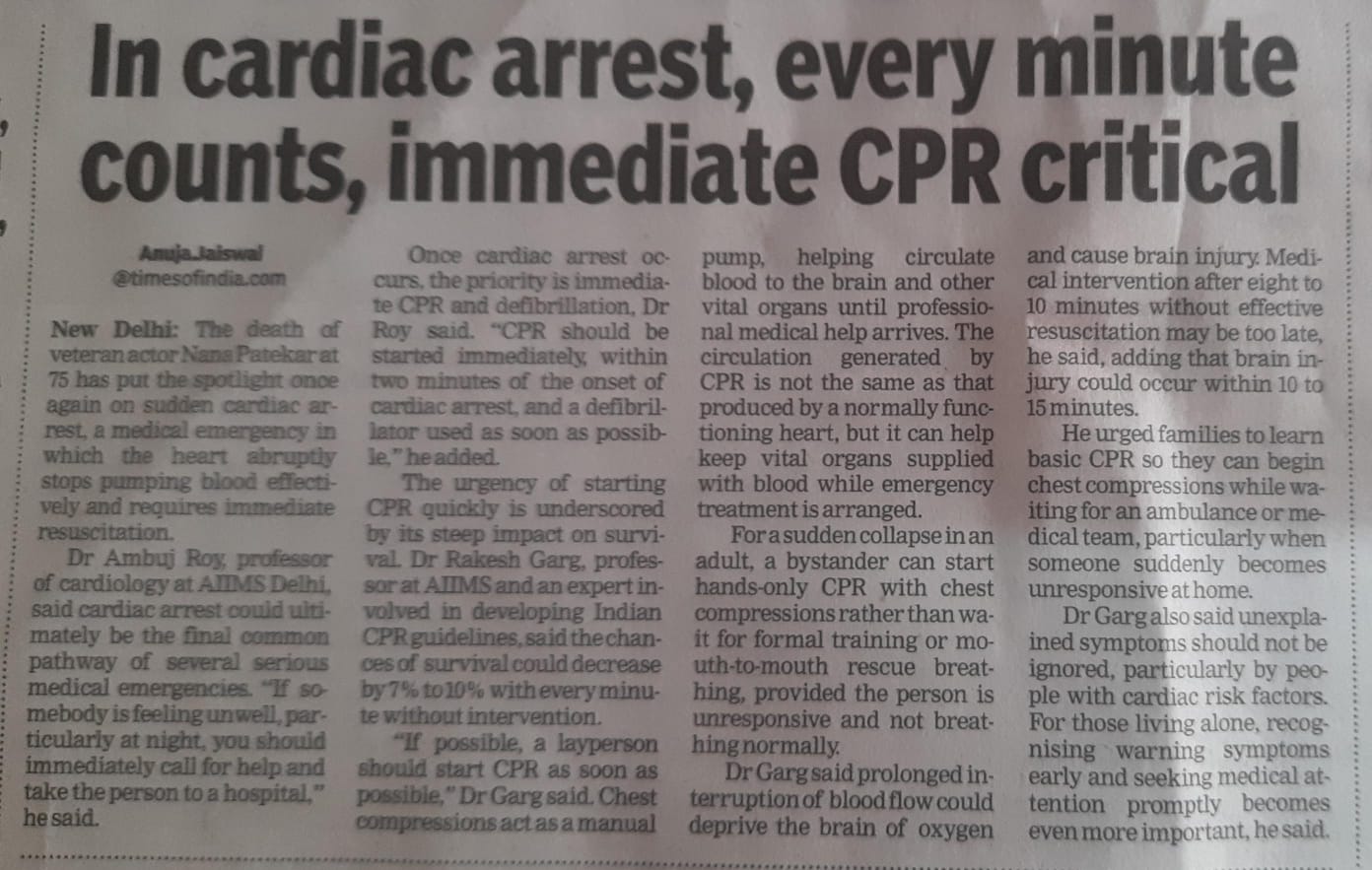
His passing has drawn attention to an emergency that can strike anyone, at home, at work or on the street. On 9 October 2026, the Mumbai edition of The Times of India spoke to senior doctors at AIIMS Delhi about sudden cardiac arrest.
Their advice comes down to one point: when the heart stops, the first few minutes decide the outcome. And the person who can help most is often a family member or bystander who starts CPR straight away.
What is sudden cardiac arrest?
Sudden cardiac arrest is when the heart suddenly stops pumping blood properly. Within seconds the person collapses, stops responding and stops breathing normally. Without immediate help, it is fatal.
Dr Ambuj Roy, Professor of Cardiology at AIIMS Delhi, told The Times of India that cardiac arrest can be the end point of several different serious emergencies. His advice: if someone feels unwell, especially at night, call for help at once and get them to a hospital.
People often use “heart attack” and “cardiac arrest” to mean the same thing, but they are different emergencies:
| Heart attack | Cardiac arrest | |
|---|---|---|
| What happens | A blocked artery cuts off blood to part of the heart muscle | The heart’s rhythm fails and it stops pumping blood |
| The person is usually | Awake and breathing, often with chest pain | Unresponsive and not breathing normally |
| What you do | Call 112 and get them to hospital fast | Call 112, start CPR at once, use an AED if one is near |
A heart attack can trigger a cardiac arrest, so treat both as life-threatening and never wait to see if symptoms pass.
Why every minute counts
The chance of surviving a cardiac arrest falls by 7% to 10% for every minute that passes without CPR. That figure comes from Dr Rakesh Garg, a professor at AIIMS who helped develop India’s CPR guidelines.
The doctors who spoke to The Times of India set out how quickly the window closes:
- Within 2 minutes: CPR should begin, said Dr Roy, with a defibrillator used as soon as one is available.
- After 8 to 10 minutes: medical help may come too late if no one has kept blood flowing, said Dr Garg.
- Within 10 to 15 minutes: the brain, starved of oxygen, can suffer injury.
An ambulance rarely arrives within two minutes, especially in a busy city like Mumbai. So the first, most important help has to come from the people already on the scene.
In India, very few people get that help. Only an estimated 1.3% to 9.8% of cardiac arrest patients receive CPR from a bystander, against a global average of about 30%, according to figures reported by The Week. More than 80% of cardiac arrests outside hospital happen at home, which means the person most likely to save a life is a family member.
How to give hands-only CPR to an adult
You don’t need formal training or mouth-to-mouth breathing to start. Dr Garg said a bystander can begin hands-only chest compressions on an adult who has collapsed, as long as the person is unresponsive and not breathing normally. India’s Compression-Only Life Support (COLS) guidelines for laypeople take the same approach.
- Check. Make sure the area is safe. Tap the person’s shoulders and shout their name. If they don’t respond and aren’t breathing, or are only gasping, treat it as cardiac arrest.
- Call. Dial 112, India’s single emergency number, or ask someone nearby to call. Put the phone on speaker. Send someone to find an AED.
- Position your hands. Kneel beside the person. Place the heel of one hand in the centre of the chest, on the lower half of the breastbone. Put your other hand on top and lock your fingers.
- Push hard and fast. Keep your arms straight and shoulders over your hands. Press down 5 to 6 cm (about 2 inches) at 100 to 120 pushes a minute. Let the chest rise fully after each push.
- Keep going. Don’t stop until an AED is ready, trained help takes over, or the person starts breathing normally. If someone else can help, swap every 2 minutes so the pushes stay strong.
Chest compressions work as a manual pump. They don’t replace a healthy heartbeat, but they keep blood flowing to the brain and other vital organs until medical help arrives.
CPR for children and infants is done differently. That technique is best learned hands-on in a certified course.
Use a defibrillator (AED) as soon as you can
CPR keeps blood moving, but a defibrillator is what can restore a normal heart rhythm. Dr Roy stressed that the defibrillator should be used as soon as possible after a cardiac arrest.
An AED (automated external defibrillator) is a portable device built for people with no medical training. It talks you through each step out loud:
- Switch it on and follow the voice prompts.
- Attach the pads to the person’s bare chest, as shown in the pictures on the pads.
- Stand clear and make sure no one touches the person while the AED checks the heart rhythm or gives a shock.
- Restart chest compressions straight after, and keep following the prompts.
AEDs are increasingly found in offices, malls, airports, gyms and housing societies. Find out where the nearest one is at your workplace and in your building today, before you ever need it.
Warning signs you should never ignore
Dr Garg cautioned that unexplained symptoms should never be brushed aside, especially by people with heart risk factors. For anyone who lives alone, he said, spotting the warning signs early and getting medical help quickly matters even more.
Get help at once if you or someone near you has:
- Chest pain, pressure or tightness, especially if it spreads to the arm, jaw, neck or back
- Shortness of breath
- Sudden sweating, nausea or vomiting
- Dizziness, light-headedness or fainting
- A racing or irregular heartbeat
- Unusual tiredness with no clear reason
The risk is higher for people with high blood pressure, diabetes, high cholesterol, a smoking habit, a family history of heart disease, or a past heart problem.
If these signs appear, call 112. Don’t drive yourself to hospital, and don’t wait to see if the symptoms go away.
Learn CPR before you need it
Dr Garg urged families to learn basic CPR, so that someone at home can start chest compressions while waiting for the ambulance. Reading a guide helps, but the confidence to act in a real emergency comes from practice.
At Eduforce, our First Aid with CPR training teaches you to:
- Recognise cardiac arrest in seconds
- Give effective chest compressions on a training manikin
- Use an AED with confidence
- Respond to choking, bleeding and other common emergencies
We train individuals, families, schools, housing societies and workplaces. Explore our First Aid with CPR programme or write to us at info@firstaidcpr.in to book a session.
The next person who collapses near you may be someone you love. Learn CPR, so that you are ready to help.
This article is for general awareness and does not replace hands-on CPR training or medical advice. In an emergency, call 112.
Source: The Times of India, Mumbai edition, 9 October 2026.