Rescue & Medical Specialists: Training Overview
Reach, Treat, and Extract Patients Where Standard Crews Cannot:
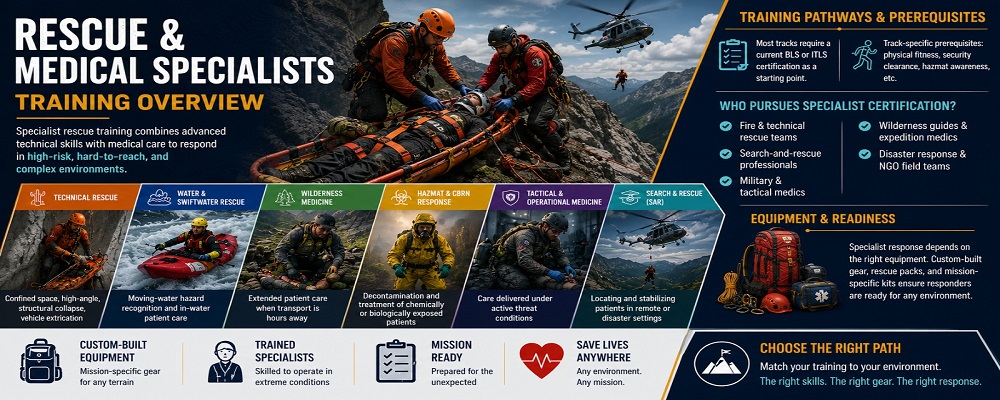
- Technical Access and Extraction: Combines rescue skills with the medical care needed to keep a patient alive once they are reached.
- Hazard-Specific Tracks: Confined space, water, wilderness, hazmat/CBRN, tactical, and search-and-rescue.
- Builds on Core Certification: Layered on existing BLS, ACLS, or ITLS skills.
- Equipment Readiness: Treats gear readiness as part of the training itself.
- Matched to Your Environment: Choose the track that fits where your responders actually work.
What Sets Specialist Rescue Training Apart?
Some emergencies happen in places a standard ambulance crew cannot safely reach — a collapsed structure, moving water, a confined space, or a hazardous materials incident. Rescue and medical specialist training closes that gap by combining technical access and extraction skills with the medical care needed to keep a patient alive once they are reached.
Unlike BLS, ACLS, or ITLS, specialist rescue training is not a single course. It is a collection of tracks, each built around a specific hazard or environment, usually layered on top of an existing BLS, ACLS, or ITLS certification, since the medical fundamentals stay the same even when the surrounding environment changes completely.