AHA BLS Certification Training in Mumbai

Build Confident, Life-Saving Response Skills with Basic Life Support (BLS) Training:

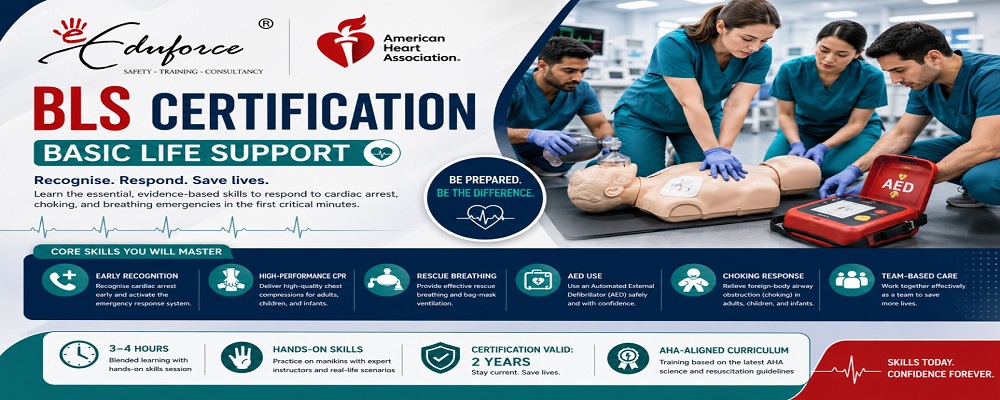
  • Evidence-Based Curriculum: Training aligned with current American Heart Association (AHA) resuscitation science and guidelines.
  • High-Quality CPR: Master chest compressions with the correct rate, depth, and recoil for adults, children, and infants.
  • AED Confidence: Learn safe, confident use of an Automated External Defibrillator (AED).
  • Hands-On Practice: Supervised skills sessions on manikins, with instructor feedback before the skills test.
  • Recognised Certification: A BLS provider card generally valid for two years from successful completion.
Closing the Gap Between Collapse and Care

A cardiac emergency can happen without warning, and the gap between collapse and the first intervention often decides the outcome. Basic Life Support (BLS) training closes that gap. It gives healthcare providers, students, and frontline responders a structured, evidence-based way to recognise a life-threatening emergency and act within the first critical minutes, well before advanced help arrives.

  • Faster Emergency Response: Staff learn to recognise cardiac arrest and act within the first critical minutes, before advanced help arrives.
  • Clinical Readiness: Teams train to a clinically accurate, skills-tested standard rather than a basic awareness session.
  • Team Coordination: Practice in coordinated, high-performance team resuscitation improves how responders work together.
  • Recognised Credentials: Certification widely accepted by hospitals, insurers, and employers.
  • Early recognition of cardiac arrest and activation of the emergency response system
  • High-performance chest compressions with correct rate, depth, and recoil for adults, children, and infants
  • Effective rescue breathing and bag-mask ventilation technique
  • Safe, confident use of an Automated External Defibrillator (AED)
  • Relief of foreign-body airway obstruction (choking) across age groups
  • Coordinated team-based resuscitation, including high-performance team dynamics
  • Healthcare Professionals: Nurses, doctors, paramedics, dental staff, physiotherapists, and allied health students.
  • Frontline Responders: Lifeguards, fitness professionals, and security personnel.
  • Workplace Teams: First-responder teams who want a clinically accurate, skills-based course.
  • Blended Learning: A self-paced knowledge module combined with a hands-on skills session.
  • Instructor-Led Skills Session: Hands-on manikin practice under an instructor’s supervision, with short video-based scenarios.
  • Duration: A typical provider course runs between 3 and 4 hours.
  • Renewal Course: A shorter refresher pathway for candidates whose card has not yet expired.