ITLS Certification: Trauma Life Support Training

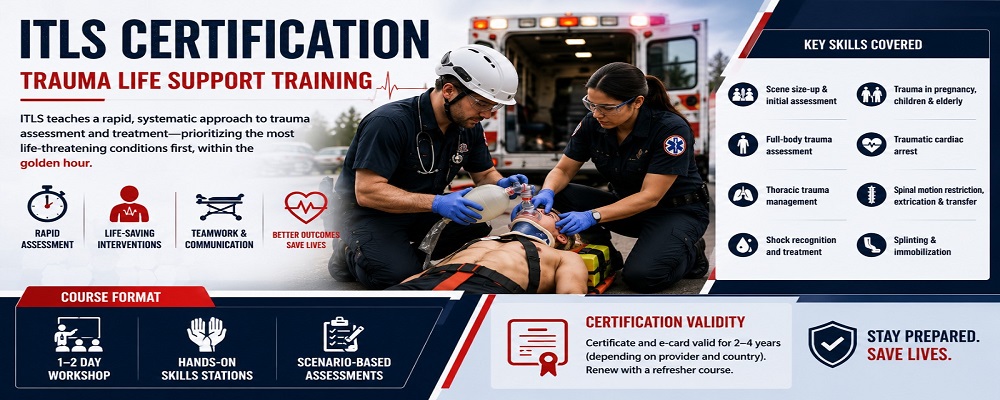
Assess and Treat Trauma Patients Fast with International Trauma Life Support (ITLS) Training:

  • Structured Trauma Assessment: A fast, repeatable way to assess a trauma patient and treat what is most likely to be fatal first.
  • Golden-Hour Focus: Built around acting within the critical window after injury.
  • Field-Ready Skills: Designed to hold up in a well-equipped ambulance or at a roadside with almost nothing to hand.
  • Hands-On Skill Stations: Spinal motion restriction, safe extrication, helmet removal, log-rolling, and splinting.
  • Global Programme: A training network spanning dozens of countries, with roots going back to 1985.

What Is ITLS and Where Did It Come From?

International Trauma Life Support (ITLS) applies the same urgency and structure as BLS and ACLS, but to injury rather than cardiac illness. The course is built around a fast, repeatable way to assess a trauma patient and treat whatever is most likely to be fatal first, usually within the critical window often called the golden hour.

The program began in 1985 under the name Basic Trauma Life Support and has since grown into a global training network spanning dozens of countries. Its curriculum draws on input from emergency physicians and prehospital providers, and it is designed to hold up whether care is delivered inside a well-equipped ambulance or on a roadside with almost nothing to hand.
  • Faster Trauma Care: Responders learn to prioritise and treat life-threatening injuries first.
  • Consistent Assessment: One repeatable assessment sequence used across your whole response team.
  • Readiness in Any Setting: Skills that work from an ambulance to a remote roadside.
  • Special Populations: Preparedness for trauma in pregnancy, children, and elderly patients.
  • Rapid scene size-up and initial patient assessment
  • Full-body trauma assessment performed under time pressure
  • Recognizing and managing thoracic (chest) trauma
  • Identifying and treating shock in the field
  • Special considerations for trauma in pregnancy, children, and elderly patients
  • Managing traumatic cardiac arrest
  • Skills stations covering spinal motion restriction, safe extrication, helmet removal, log-rolling, backboard and scoop stretcher use, and splinting
  • EMTs and paramedics
  • Emergency and trauma nurses
  • Combat and tactical medics
  • Physicians working in emergency or prehospital medicine
  • Nursing, medical, and paramedic students preparing for field placements
  • Workshop Format: Usually delivered as a one- or two-day workshop.
  • Classroom Instruction: Core trauma assessment and management principles.
  • Skill Stations: Hands-on practice of practical trauma skills.
  • Scenario-Based Assessment: Candidates are tested on applying the assessment sequence under realistic pressure.